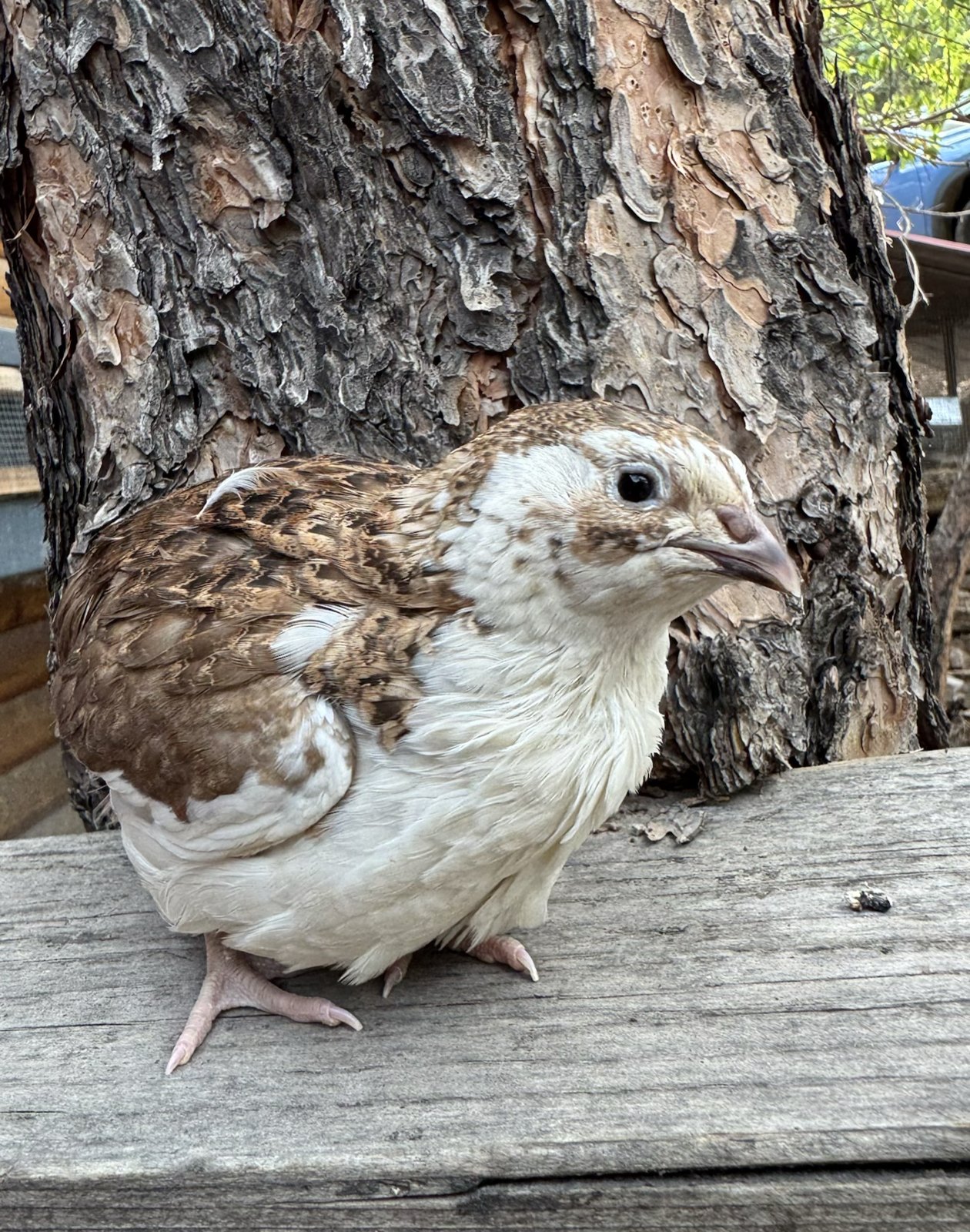
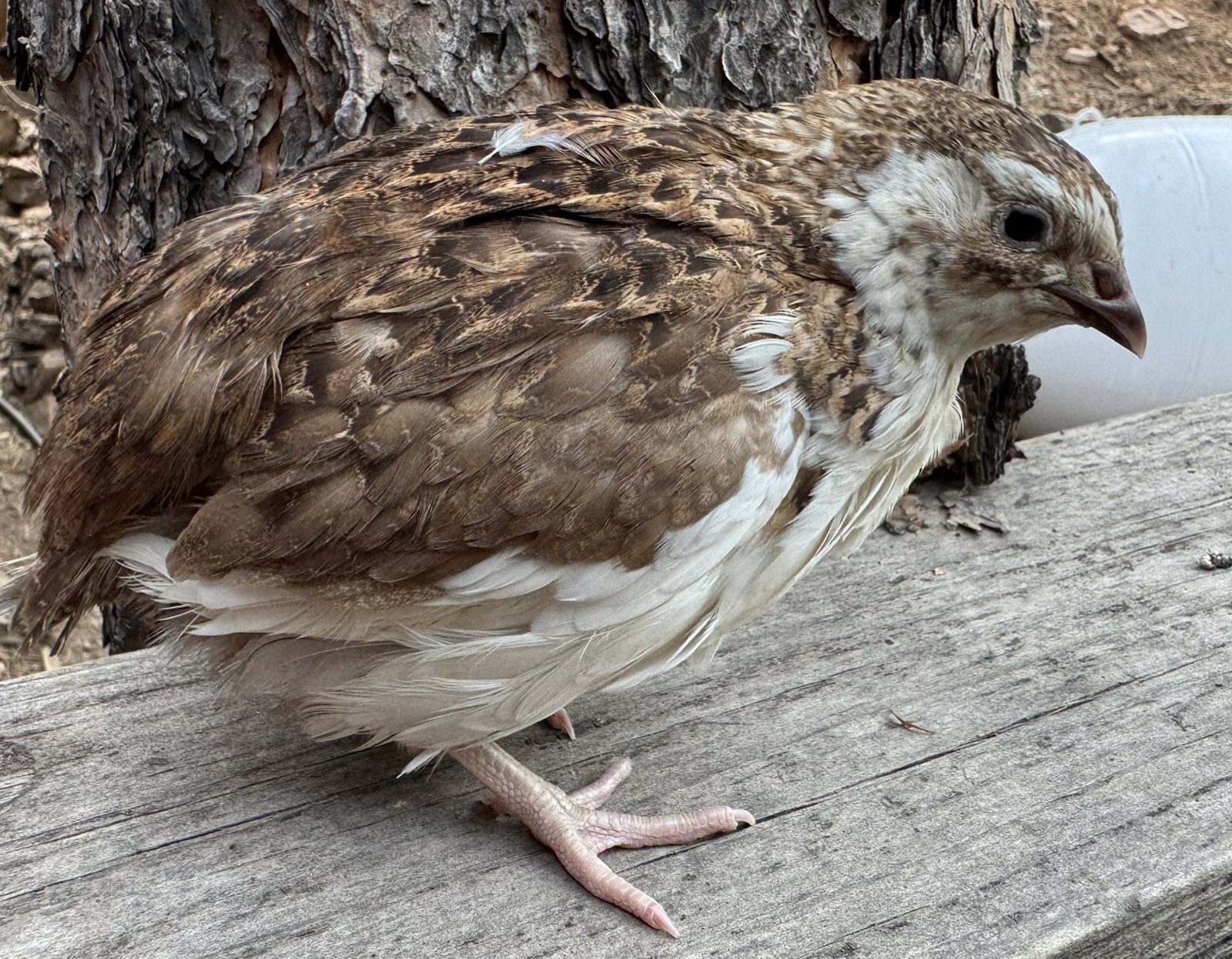
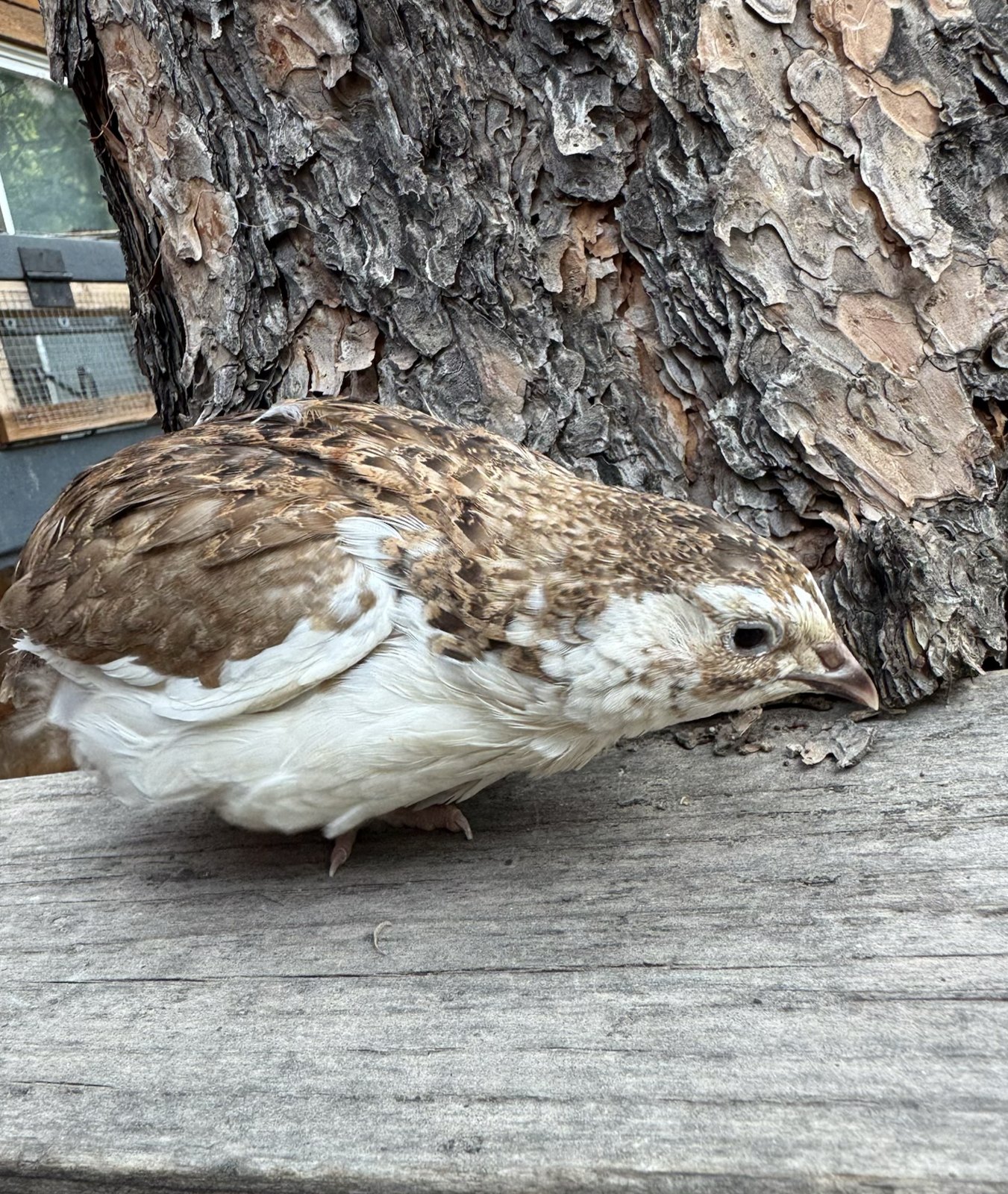
Tuxedo and Fee together, and the clearest demonstration here of why those two traits are hard to read at once. Tuxedo whites out the breast and belly; what color is left is pulled back to a soft sandy fawn by Fee.
| Variety | Range (jumbo line) |
|---|---|
| Pen ID | Range 5 |
| Sex | Male (vent-checked, not feather-sexed) |
| Tuxedo | Yes |
| Fee | Yes |
| Weight | 198 g (7.0 oz) |
| Boulder County Fair 2026 | First place, Coturnix quail (Danish system: more than one blue can be awarded in a class) |
| Temperament | Handled daily since hatch; calm in the hand |
| Feed | 100% certified organic, whole life (organic starter, then organic grower) |
| Raised by | Colin, 4-H poultry project, Lyons, Colorado |
Every quail here has eaten 100% certified organic feed for its entire life. Organic chick starter from the day it hatched, then an organic grower ration. No conventional feed, ever.
198 g · 7.0 oz
Weighed 3 Aug 2026
| This bird | 198 g |
| Published mean, large-sized strain, adult male | 188.0 g |
| Published mean, normal-sized strain, adult male | 121.1 g |
That puts him about 5% above the published mean for a large-sized strain, and well clear of a normal-sized one. One honest caveat: that study weighed its birds at 16 weeks, and strain, age, feed and season all move the number. Treat this as a real measurement of one bird, not a guarantee about his offspring.
Haqani MI, Kawamura K, Takenouchi A, Kabir MH, Nakamura Y, Ishikawa A, Tsudzuki M. A growth performance and nonlinear growth curve functions of large- and normal-sized Japanese quail (Coturnix japonica). The Journal of Poultry Science 2021;58(2):88–96. Read the source
Legolas weighed 198 g on 3 Aug 2026, which is about 5% above the published mean for an adult male of a large-sized strain. That is a measurement of one bird on one day, not a promise about his offspring.
He brings white tuxedo marking and Fee, the red-reduction trait. Worth knowing before you bid: tuxedo is probably, but not provably, the published white-spotting locus, and Fee has no published gene at all. Both are breeder conventions. We can tell you what this bird looks like and what its parents looked like; we cannot quote you inheritance ratios, and anyone who does is going beyond the evidence.
Handled almost every day since hatch by Colin and his sisters, so he sits calmly in the hand and does not flare or scramble when picked up. Temperament is worth asking about and worth watching, but it is a product of how a bird is raised as much as of its breeding, so treat it as a fact about this bird rather than a promise about its chicks.
Legolas was sexed by vent examination, not by plumage. Range is built on extended brown, which overwrites the wild-type breast pattern, so Range birds, tuxedo or not, cannot be feather-sexed. White on the chest here means tuxedo and nothing else.
He was shown at the Boulder County Fair 2026 and entered in the poultry sale on 9 August. Nothing sold at the sale, so he came home with us. Email before you plan around him and we will confirm he is still here. Hatching eggs and chicks from his pen are available either way.
What we have not measured: we do not keep individual laying records, fertility rates or hatch rates on these birds. If we quoted you a number for any of those, we would be guessing, so we don't. Ask us at the pen and we will tell you exactly what we have seen and what we haven't.